I founded Hostile Sheep on my hot-take that design isn't a professional service. My belief, for decades, has been design is much more like a trade and should adopt certain things from how trades operate. One thing, among many, is the concept of hand-on learning. This is in tension with professional services which often provide oversight where hands-on learning could be more effective. Professional services are well known for their hierarchical 'career ladders' where directors oversee design, providing critique, without actually doing design anymore. Trades, and craftspeople in particular, pass down techniques, tools, and knowledge to apprentices. They sit at the intersection of art and economics. A chef may add acid to a dish that doesn't ask for it, and it's more tasty because of it. A stone worker may add an embellishment that wasn't planned for, and it's more beautiful because of it. A musician may play their instrument in exactly the wrong way, and it gives the audience shivers. Ok, so that's belief colours my next statement, which may also be provocative: AI can't replace craftspeople.
I'm an experience designer, what does that mean for me? Well, firstly, let me just say I don't have my head stuck in the sand. I've heard all of the arguments for using AI. There are lots of organizations that seem to be throwing the baby out with the bathwater in the context of AI. I understand that my industry, like most others, are being shaped by AI. But, in the context of trades and craftspeople, I like to think of AI as a tool. A robust tool, sure, but a tool just like a hammer or a paint brush. It helps us; it doesn't replace us.
Why I work
"The law of work seems unfair, but nothing can change it; the more enjoyment you get out of your work, the more money you will make." - Mark Twain
Those who know me, may be familiar with my LinkedIN profile headline that says "I create things that make people smile." While cute and disarming, it's not exactly why I work. I work to make myself smile. It took a long time to realize that. It took an even longer time to figure out how to make myself smile; like, a for real smile.
Why was it so hard to figure out what made be smile? Because I was conditioned to smile for all kinds of reasons. A real smile wasn't just a physiological reaction, it taps into who I am. It taps into what I really care about. In many ways I needed to figure out who I am. I'm still changing and still finding out who I am, so it's really a never-ending quest. I know what kind of work will make me smile today and leave space for that to change tomorrow. AI doesn't get joy from the work we use it for.
Art and the machine
I work in the field of design which is adjacent to art. Its likely easier for me to think about my work as sitting at the intersection of art and economics than other industries. One of the biggest similarities between art and design is knowing when it's done. Do I add another button? Do I add another menu item? Do I add another screen, another step, another icon, another font, another, another, another?
"To finish a work? To finish a picture? What nonsense! To finish it means to be through with it, to kill it, to rid it of its soul..." - Pablo Picasso
Can an AI produce a work capable of moving me to tears? I bet it can. The question isn't so much about whether I can appreciate a piece of art, it's about where the work comes from. We're in the early days of machines being able to create beautiful things. We can appreciate them because they are remixes of our own work. The machine can create a beautiful image in the style of Picasso or Warhol or Dali, but artists don't create because you asked for it. They create because its rewarding, in many cases unimaginably rewarding in the most unique way.
"Practicing an art, no matter how well or badly, is a way to make your soul grow, for heaven's sake. Sing in the shower. Dance to the radio. Tell stories. Write a poem to a friend, even a lousy poem. Do it as well as you possibly can. You will get an enormous reward. You will have created something." - Kurt Vonnegut
In many ways, practicing design makes me smile when the initial design has been created. When the unaltered, unrefined design has come out of me. Even better when it's a collaborative a shared experience; it feels great when that first iteration is out of our minds and living on its own. I share this because, in the field of experience design, that first iteration will likely never be seen by anyone; it's just a starting point. I hear the same from some of my artist friends; the most "saleable" works aren't always the ones that bring the most joy. When those artists are asked about using AI they often laugh. "If I ever need to use AI to help me create, I'll stop creating." I'm of the mind that AI can be seen as a helpful tool; much like lithography or using printing presses. Previous to AI, machines helped more people experience an artists work, it didn't risk replacing the artist entirely. AI can generate the work, but it cannot be moved by the creation.
What the machine missed
AI can create 'good enough' designs in seconds. It's efficient. So efficient that organizations are firing human designers because it can design an entire website in the time a human can use the restroom. As the use of AI sweeps the globe, how long will it be before we're inundated in an ocean of sameness? If every organization can use AI to create designs in seconds, where do our points of differentiation lie? I don't think we take what AI gives us and ship it as is. I think AI is moving the baseline but not the ceiling. Sure, all those garbage designs that the burnt out, unmotivated, and uninspired designers were pumping out are gone. AI can produce better in seconds.
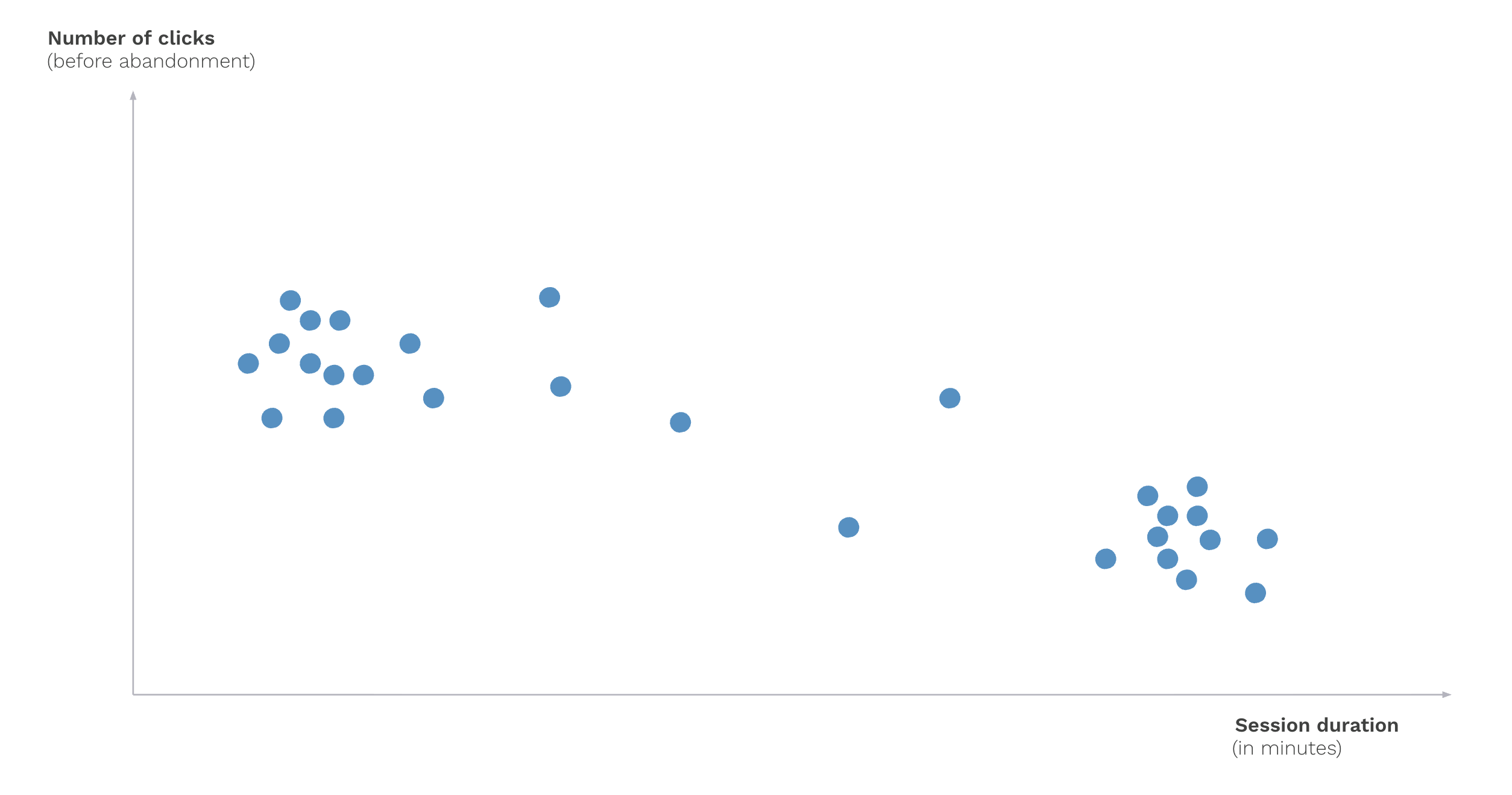
Imagine a scenario where we have some data about how users interact with our app. We give this plot to a designer and to an AI and ask for a redesigned app. What do you think we'd get?
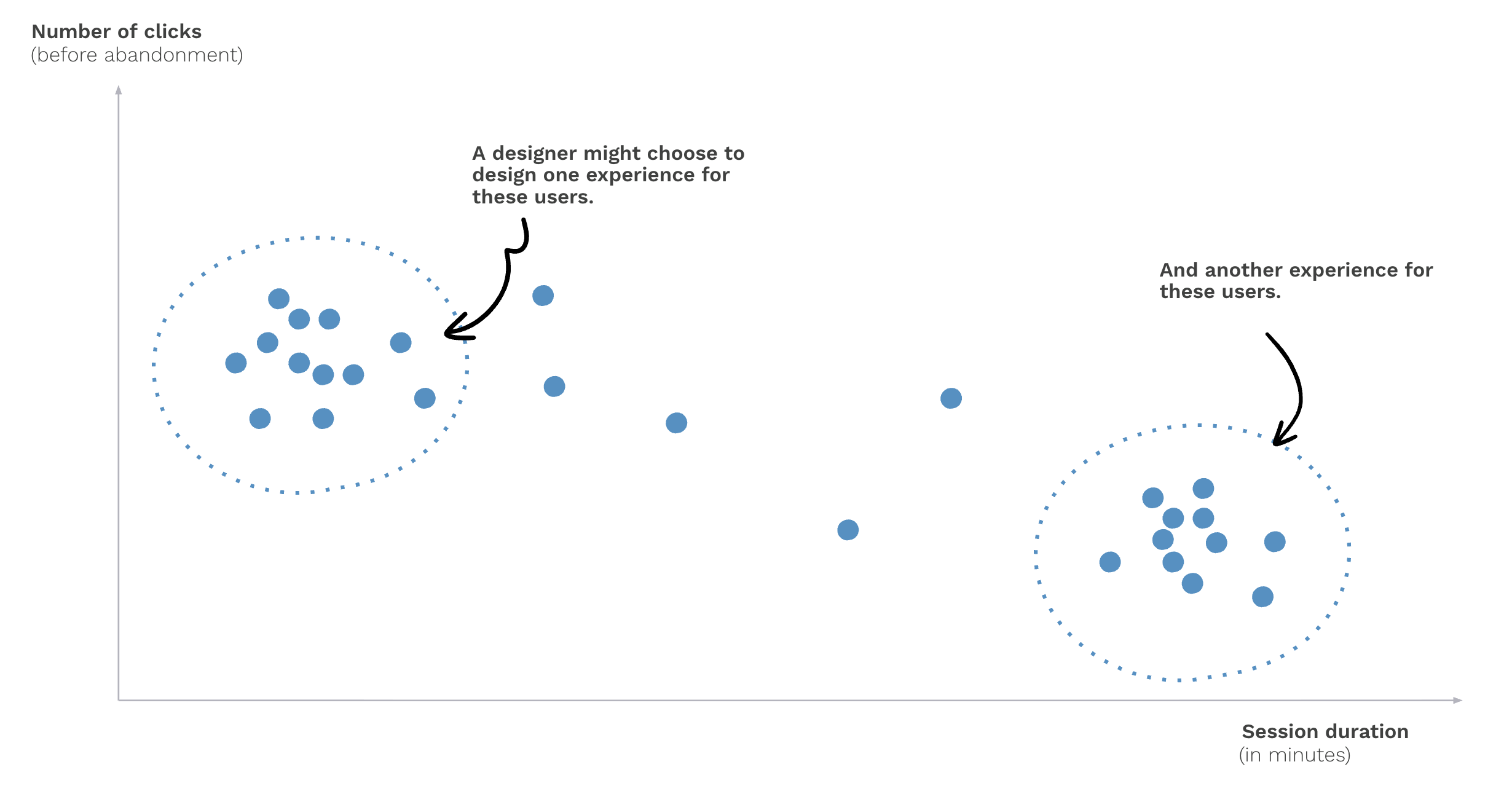
The designer may choose to ignore your request for a redesigned app and say, we actually need to create two experiences. One group of our users is willing to click to find information quickly while the other group doesn't want to click, but is willing to spend time sifting through content to find what they want.
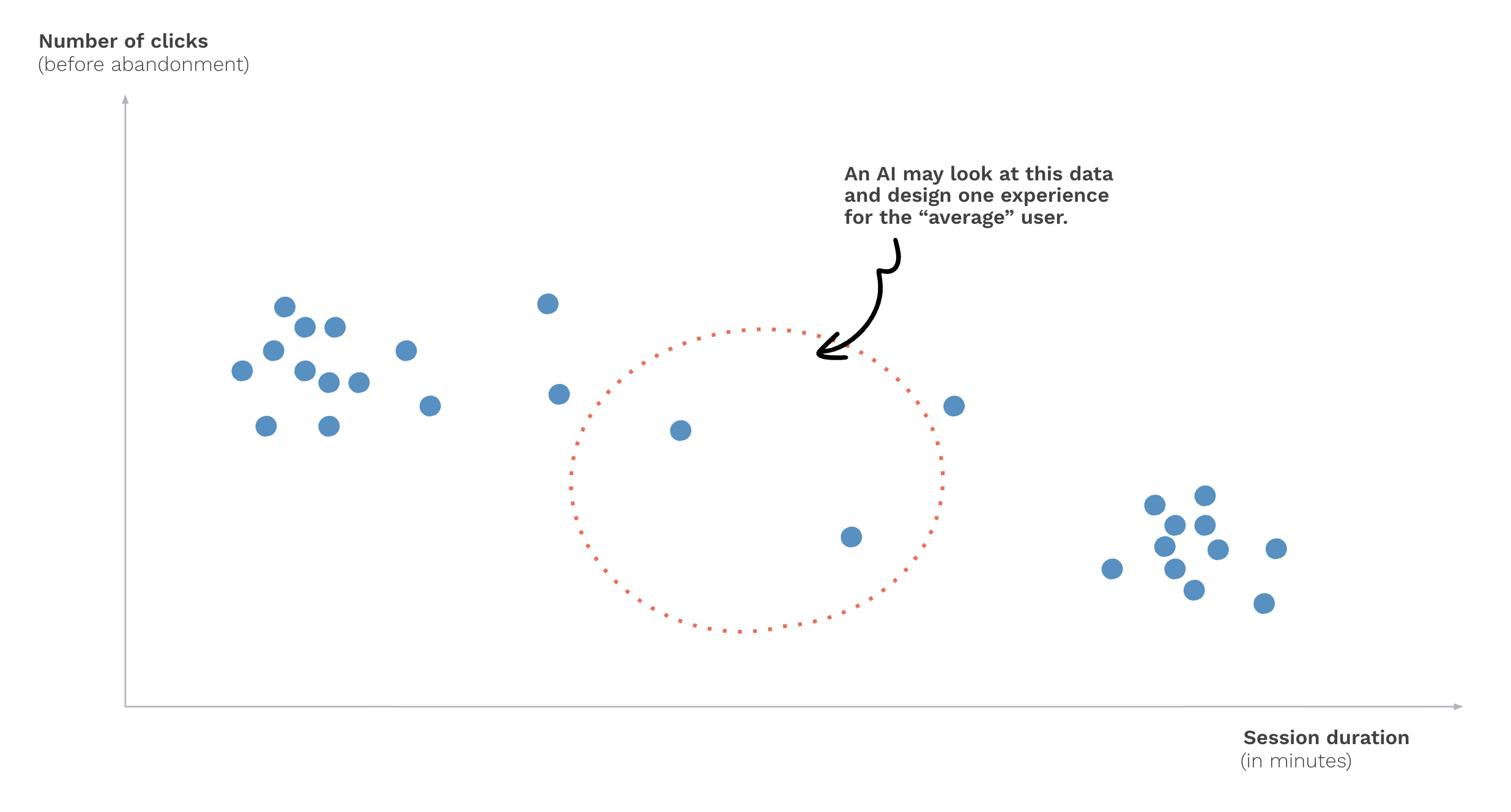
The AI may follow your prompt by creating one redesigned app for the "average user". By looking at all of the clicks and averaging them, then looking at all of minutes spent per session and averaging them. We now have a perfect design for the average user, who may (coincidentally) not exist. Ok, so, not so useful as a target state ... but perhaps a good starting point.
The role of design is evolving into something that can stand on the shoulders of the machine and elevate it from basic to beyond. If AI can do all the work designers never wanted to do in the first place, what does that free us up to do?
"The longer I live the more beautiful life becomes. If you foolishly ignore beauty, you will soon find yourself without it. Your life will be impoverished. But if you invest in beauty, it will remain with you all the days of your life." - Frank Lloyd Wright
With the baseline elevated, with the production work offloaded, designers can reinvest in beauty. Not just by investing in the superficial but by investing in uncovering the essential truth of a situation.
- The beauty of radical empathy: we can invest in the quiet, often overlooked struggle of the user. It's the beauty found in designing a path for the person on their worst day. The person who's grieving, panicked, or confused and ensuring they feel seen rather than merely processed.
- The beauty of systemic integrity: we can choose to finally fix the rot in the foundation rather than just painting the facade. There is a deep, architectural beauty in a system that is honest, transparent and built to protect the users data and dignity over the organizations immediate measures of success.
- The beauty of perspective shifting: we can start using design as a mirror to show users a version of the world they hadn't considered. It's the beauty of turning a disgusting or complex point of friction into an elegant point of realization. It's the beauty of helping a user discover wonder in a mundane task through elevated design.
- The beauty of ethical friction: we can override AIs penchant for efficiency by intentionally slowing down users who experience harm when moving too fast. It's the beauty of designing a moment of pause that protects a person's finances, mental health or relationships from the speed-driven mistake.
- The beauty of epiphany: we can take our time to discover that one human insight that renders a hundred features obsolete. There is a certain kind of beauty in the killer feature that solves a problem so perfectly it feels like it's always existed.
- The beauty of belonging: we can find the grace in the accessible. It often involves a realization that a feature designed for an edge case can often improve the experience for everyone. It's the beauty of a product that refuses to leave people behind.
Remember design quality is subjective
Have you ever sat in a boardroom when a designer was presenting their work? It often devolves into a design-by-committee scenario. Why is that button there? Can we move it? Can we make it a different colour? Is it a defensible decision? What data was the decision based on? Maybe we should test it an optimize it? How can we get to an objective measure of good?
AI is objective. It looks at the average of everything its learned and gives us the most statistically probable correct solution. This is why AI is taking jobs, it's the objective way to make design decisions. So, that must mean AI is the best way to make design decisions right?
Well, I see design quality in terms of a polarity map. I absolutely recognize that AI allows us to jump directly into code and produce high fidelity interactive experiences right away. There are positives and negatives associated with being that agile. On the other side of the polarity map, sits rigorous design; the kind that uses evidence-based decision making, edge-case hunting, ethical inquiries, and other process. This kind of design also has positives and negatives.
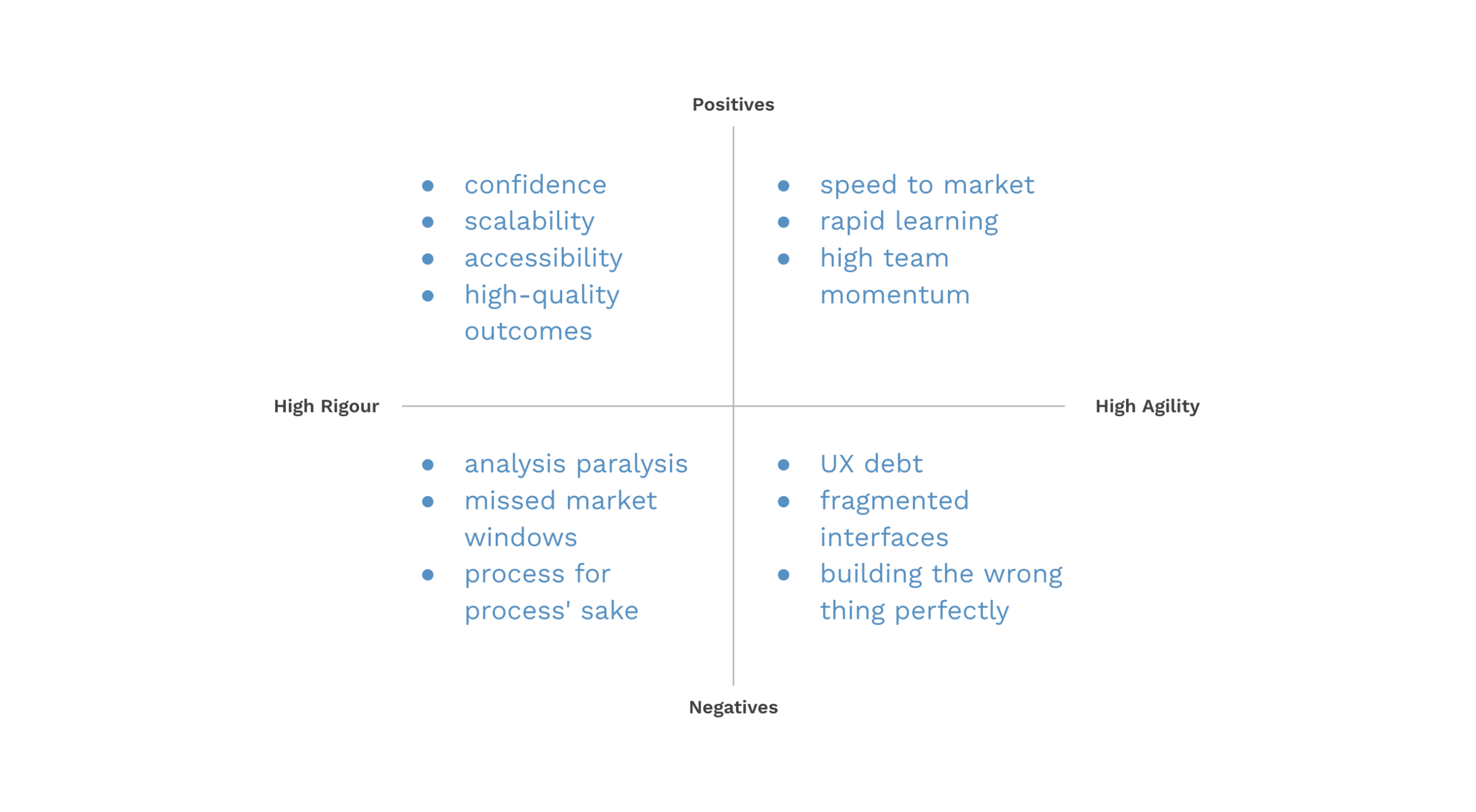
Those who understand polarity management understand that it's useless, and draining, to argue about which pole is right. The fact is, this has been a polarity for the past 50 years and will be a polarity for the next 50. AI has had an impact on how agile we can be, but it's also had an impact on how rigorous we can be. The goal of polarity management is to recognize when we're slipping into the lower (negative) quadrants, and gently move ourselves into the positive side of the opposite pole.
Ok, so let's go back to the boardroom design-by-committee discussion; the goal is to remove the subjectivity from the design. We don't like the idea of a designer relying on their biases and intuition to make decisions. Well, here's a secret: it's unavoidable. Someone needs to make a decision; while we can help designers make better decisions, we can't remove the inherent subjectivity that comes with making design decisions.
I don't think the quality of design can be measured by how rigorous or how agile we are. I think the highest quality design work recognizes the subjective nature of design and tries to find the balance between competing perspectives and priorities. Designers usually have to accept:
- It's not obvious: it's the ability to look at ten functional AI designs and determine which ones feel cheap and which ones feel cherished. How to change a cheap design to make it feel cherished. How to avoid a cherished design from being over-designed into cheapness.
- It's a moral choice: it's deciding that manipulating the user, regardless of what the data says, doesn't align with the kind of beauty we want to put into the world. It's being able to weigh the cost of short term revenue with that of long term trust.
- It's rarely perfect: it's the realization that the imperfect can outperform the perfect. A perfect design system that's perfectly consistent may actually be so boring that users stop paying attention. An imperfect system may use a weird color combination or an inefficient animation but results in loyalty, conversion, trust, and sharing.
AI doesn't have a favourite colour. It doesn't have a childhood memory. It doesn't know why a specific curve makes me smile. That's what makes us different. We're not the average of millions of inputs, we're all different. We're all unique. We're all special and I think our subjectivity is something worth protecting.
More from our blog
Reflections on Trauma, Consent, and Design.
Jul 14, 2026
Credit Rehabilitation Project Story
Jun 17, 2026
Agency is the outcome: Why feeling in control is the ultimate user experience.
May 15, 2026
Are you a Challenger? Why out-caring the giants is your only real advantage.
May 14, 2026